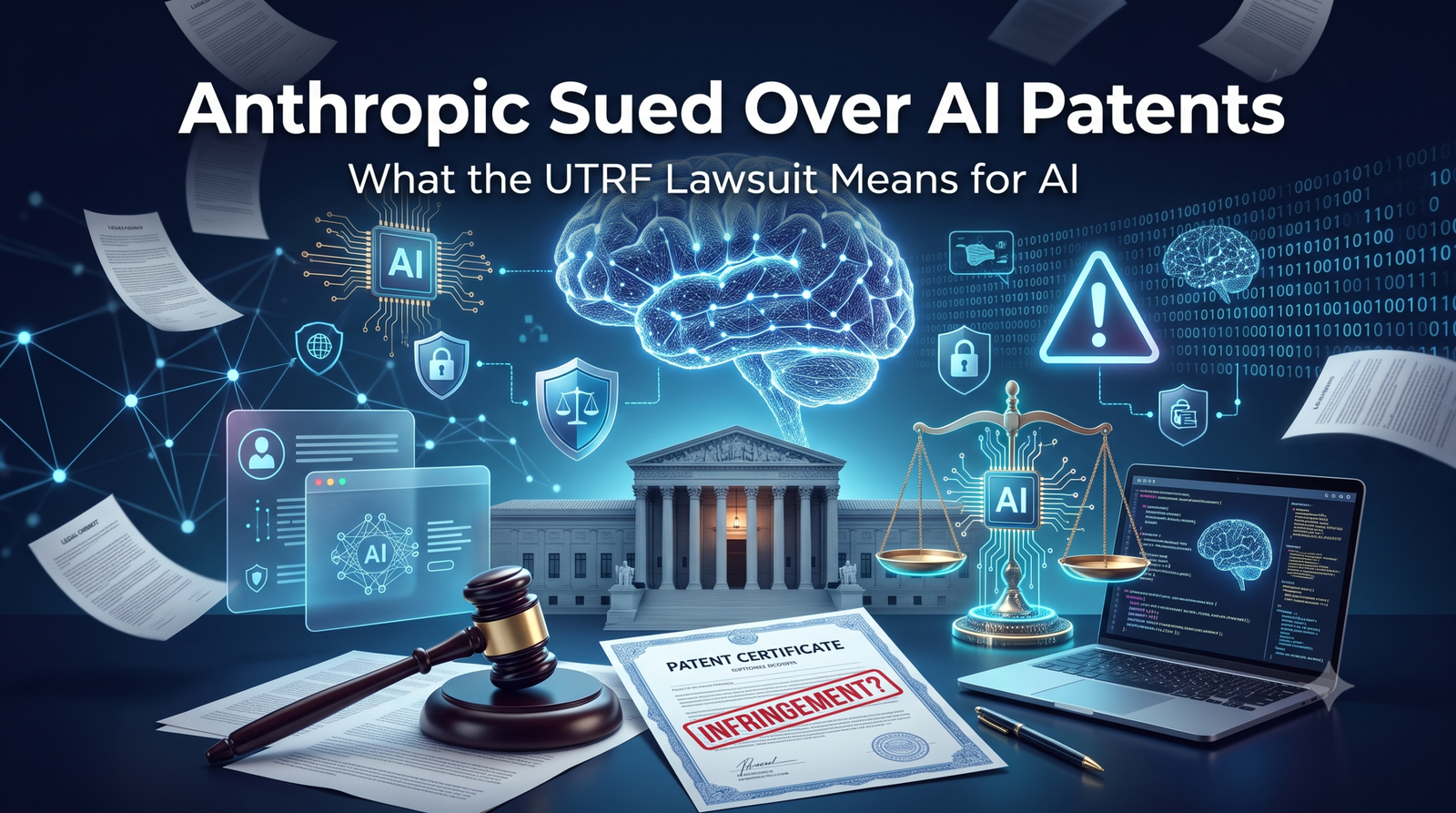
Anthropic faces its first patent lawsuit as the University of Tennessee Research Foundation accuses Claude AI of infringing neural network patents. Here’s what’s at stake.
Anthropic’s legal troubles just took a sharp turn. For nearly two years, the Claude AI maker has mostly been fighting battles over copyright — whether it had the right to train its models on authors’ books. This week, a new front opened: a lawsuit accusing Anthropic of stealing someone else’s patented technology, not just their words.
On July 21, 2026, Reuters reported that the University of Tennessee Research Foundation (UTRF) had filed a complaint in Delaware federal court, alleging that Anthropic’s AI systems infringe patents covering neural network technology inspired by neuroscience. It’s believed to be the first patent infringement case ever filed against Anthropic — and it lands at an unusually turbulent moment for the company’s legal team.
Below, we break down who’s suing Anthropic, what the patents actually cover, why the timing matters, and what this could mean for the broader AI industry.
Who Is Suing Anthropic, and Why?
The plaintiff isn’t a rival AI lab or a shadowy patent troll. It’s the University of Tennessee Research Foundation, the nonprofit organization that manages and licenses intellectual property developed by University of Tennessee researchers. UTRF’s complaint, filed Monday, July 20, and made public Tuesday, July 21, accuses Anthropic of building AI systems that violate patents covering machine-learning technology inspired by neuroscience.
According to the foundation’s filing, Anthropic infringed two specific patents:
- U.S. Patent No. 10,019,470
- U.S. Patent No. 10,095,718
Both patents relate to improvements in artificial intelligence systems tied to neural networks, and both were developed by University of Tennessee researchers. UTRF’s complaint doesn’t mince words about how it views Anthropic’s conduct. In its filing, the foundation stated:
“Anthropic’s cavalier approach to others’ intellectual property rights in the development of its products extends beyond the use of copyrighted material.”
That line is a pointed reference to Anthropic’s long-running copyright disputes — more on that below — and it signals that UTRF wants the court to see this as part of a pattern, not an isolated incident.
What Product Is Actually Being Targeted?
This isn’t a vague, sweeping claim against “Claude” as a brand. According to reporting from Bloomberg Law, the complaint specifically targets Claude Code, Anthropic’s agentic coding tool, and its underlying software architecture.
UTRF alleges that Claude Code implements patented methods for constructing neuromorphic networks — specifically pointing to a background execution scheduling system and a memory consolidation engine, both of which the foundation says are protected under the ‘470 patent. In plain terms, the university’s researchers claim that the way Claude Code manages tasks and retains context while operating autonomously mirrors techniques their scientists patented years earlier for neuroscience-inspired computing systems.
The underlying research traces back to the University of Tennessee’s TENNLab Neuromorphic Computing Research Group, a team that has spent over a decade developing brain-inspired computing frameworks — including spiking neural network architectures — and has racked up multiple issued patents along the way. UTRF is essentially arguing that Anthropic’s engineers, whether knowingly or not, built commercial products on ground the university’s scientists had already staked out.
UTRF is asking the court for two things: an unspecified amount of monetary damages, and an injunction blocking Anthropic from continuing to infringe the patents. That second request is the one that should worry Anthropic most — a successful injunction could theoretically force changes to how Claude Code operates.


Anthropic’s Response
Anthropic isn’t rolling over. A company spokesperson responded to the lawsuit by stating that Anthropic disagrees with the allegations and intends to defend the case vigorously. That’s a standard, measured litigation posture, and it tells us the case is likely headed toward a lengthy discovery and claim-construction process rather than a quick settlement — at least for now.
Timing Couldn’t Be Worse (Or Better, Depending on Your Perspective)
Here’s what makes this story more than a routine patent dispute: it landed on Anthropic’s desk in the same week — arguably the same day — as a separate, massive legal resolution.
Just as UTRF’s patent complaint became public, a California federal judge approved Anthropic’s landmark $1.5 billion settlement of a class action copyright lawsuit. That case, brought by authors Andrea Bartz, Charles Graeber, and Kirk Wallace Johnson, accused Anthropic of training Claude on pirated copies of copyrighted books — with a judge previously suggesting Anthropic may have downloaded as many as seven million books from pirate sites. The settlement is widely described as the largest of its kind in AI copyright litigation to date.
So in the span of about 48 hours, Anthropic went from closing the book (so to speak) on its biggest copyright headache to opening a brand-new front in patent law. For a company that has spent years marketing itself as the safety-conscious, “responsible” alternative in the AI race, the optics are rough: two separate plaintiffs, two separate legal theories, one shared accusation — that Anthropic built its products on other people’s intellectual property without permission.
Why This Case Is Different From Anthropic’s Other Lawsuits
It’s worth pausing on why a patent suit is a meaningfully different kind of threat than a copyright suit, even though both fall under the broad umbrella of “IP litigation.”
Copyright cases like the Bartz settlement centered on training data — the books, articles, and text Anthropic used to teach Claude how language works. Those suits challenge input: what content went into the model.
Patent cases challenge something deeper: the methods themselves. A patent claim can target a specific technical architecture, a scheduling algorithm, a memory system, or an engineering approach — the actual machinery of how a product functions, independent of what data trained it. As legal industry publication ip fray noted, patent rights are quickly emerging as a new flashpoint in AI litigation, distinct from the copyright battles that have dominated headlines around OpenAI, Meta, and Anthropic alike.
That distinction matters enormously for remedies. You can settle a copyright dispute with a payout and move on, largely unchanged. A patent injunction, by contrast, can force a company to redesign or license the very way its software operates — a far more disruptive and expensive outcome.
Why UTRF’s Case Carries Institutional Weight
It would be easy to dismiss a university foundation’s lawsuit as a minor academic footnote, but UTRF isn’t a fringe player. The foundation has a demonstrated track record of securing and defending patents tied to neuromorphic and neuroscience-inspired computing — technology that mimics how the human brain processes information, a research area that has quietly underpinned decades of AI hardware and software innovation.
UTRF is represented by attorneys from Berger & Hipskind and Farnan LLP, signaling a well-resourced legal strategy rather than a speculative long-shot filing. The foundation’s willingness to go after a company as prominent as Anthropic suggests it believes its underlying patents — and its case for infringement — are strong enough to withstand serious scrutiny in federal court.
What This Means for the Broader AI Industry
Zoom out, and this lawsuit is a preview of a legal trend that’s likely to accelerate. As generative AI tools become embedded in enterprise software, consumer apps, and coding workflows, the companies and universities that hold foundational patents in machine learning, neuromorphic computing, and related fields have every financial incentive to enforce them.
A few implications worth watching:
- Patent risk is becoming a standard cost of doing business in AI. Just as copyright lawsuits forced AI labs to rethink training data sourcing and to strike licensing deals with publishers, patent suits could push developers toward pre-launch legal review and cross-licensing agreements before shipping new features.
- Universities are increasingly willing to litigate. Academic research institutions have filed patents on AI-adjacent technology for years, often without commercializing it directly. As frontier AI companies generate massive revenue, expect more universities and research foundations to test whether their dormant patents have infringement claims worth pursuing.
- Agentic AI tools are a new target. It’s notable that this suit zeroes in on Claude Code’s agentic architecture — the systems that let AI operate autonomously across multi-step tasks — rather than the core language model itself. As agentic AI products proliferate across the industry, the underlying orchestration, scheduling, and memory systems that make them work may become fertile ground for further patent claims.
- Legal exposure is stacking up, not replacing itself. Anthropic’s copyright settlement didn’t close the book on its IP risk; it simply cleared one chapter while a new one opened. Companies building foundation models should expect parallel legal fronts, not sequential ones.
What Happens Next
The case, filed in the U.S. District Court for the District of Delaware, is still in its early stages. Anthropic has signaled it will fight the claims rather than settle quickly, which means the public should expect a drawn-out process involving claim construction, expert testimony on what “neuromorphic” architecture actually means in Claude Code’s design, and likely months (if not years) before any resolution.
Whether UTRF’s patents hold up against Anthropic’s defense will hinge on highly technical questions: Do the specific mechanisms in Claude Code — the background execution scheduler, the memory consolidation engine — actually match what the university’s patents claim, or is Anthropic’s implementation different enough to avoid infringement? Those are the kinds of questions that patent litigation, unlike copyright disputes, is built to resolve at a granular, engineering level.
The Bottom Line
Anthropic just traded one massive legal liability for a new one. The $1.5 billion copyright settlement addressed how Claude was trained; the UTRF lawsuit questions how Claude — specifically Claude Code — actually works under the hood. For an industry that has largely treated copyright as its central legal battlefield, this case is a reminder that patents covering the technical architecture of AI systems may be the next major arena where billions of dollars, and the future design of AI products, get decided.
As one of the most visible companies in the generative AI race, Anthropic’s handling of this case will likely set a precedent — or at least offer an early signal — for how patent disputes involving neural network technology play out across the rest of the industry. Anyone building or investing in AI products would do well to watch this one closely.
This article is based on reporting from Reuters, Bloomberg Law, and ip fray as of July 22, 2026. Court filings are ongoing, and details may be updated as the case progresses.