Small business ransomware attacks aren’t isolated incidents — they’re often the first step into enterprise networks. Here’s how attackers exploit supply chains and what businesses of every size can do about it.
When people picture a ransomware attack, they usually imagine a single victim: one company, one locked network, one ransom note. That mental model is outdated, and it’s dangerously incomplete. In 2026’s threat landscape, a ransomware attack on a five-person accounting firm or a regional HVAC contractor is rarely just about that business. Increasingly, it’s the opening move in a much larger campaign — one that ends with a Fortune 500 company, a hospital network, or a government agency locked out of its own systems.
Small businesses aren’t just collateral damage in the ransomware epidemic. They’re infrastructure for it.
Why Attackers Target Small Businesses First
Cybercriminals are pragmatic. They go where the resistance is weakest and the payoff is highest, and small businesses check both boxes in ways most owners don’t realize.
Limited security budgets. A small business rarely has a dedicated security team, let alone a chief information security officer. IT is often handled by a part-time contractor, an overworked office manager, or nobody at all. That means outdated software, unpatched systems, and weak password policies persist far longer than they would at a larger firm.
High-value connections, low-value optics. A twelve-person marketing agency might not look like a lucrative target on its own. But if that agency has VPN access into three enterprise clients’ networks to manage their ad campaigns, it’s not a small target anymore — it’s a bridge.
Underestimation of risk. Many small business owners assume they’re “too small to be a target.” Attackers count on this. Automated scanning tools don’t discriminate by company size; they discriminate by vulnerability. A business with an exposed remote desktop protocol (RDP) port or an unpatched VPN appliance will get flagged by the same bots scanning for Fortune 100 weaknesses.
Faster payouts. Small businesses often pay ransoms faster than large enterprises because they can’t absorb even a few days of downtime. That reliability makes them attractive, low-friction revenue for ransomware operators — a steady baseline of cash flow while they hunt for bigger scores.
The Supply Chain Is the Real Target
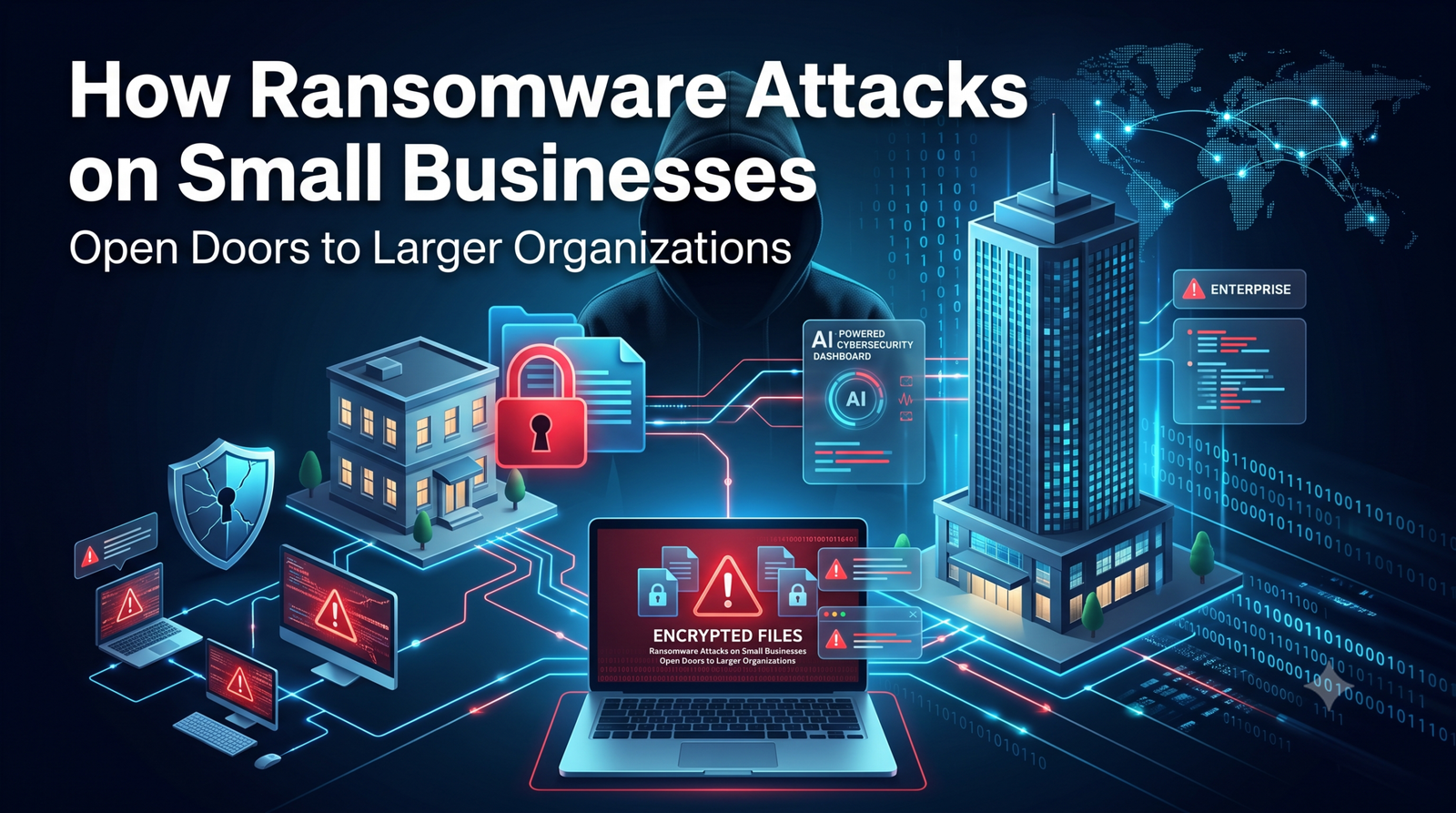
This is the part most headlines miss: modern ransomware campaigns are increasingly supply chain attacks in disguise. Attackers don’t necessarily want your data or your ransom money — they want what your business can reach.
Here’s how the chain typically works:
- Initial compromise. Attackers breach a small vendor, contractor, or service provider — often through phishing, credential stuffing, or an unpatched vulnerability.
- Reconnaissance. Instead of immediately deploying ransomware, sophisticated attackers sit quietly inside the network. They map out what systems the small business can access, what larger clients or partners it serves, and what credentials or trust relationships exist.
- Lateral movement. Using the small business as a launchpad, attackers pivot into connected networks — a client’s shared portal, a vendor management system, a managed service provider’s remote access tools.
- Privilege escalation. Once inside the larger organization’s environment, attackers work to gain administrative access, often targeting backup systems first so recovery becomes as difficult as possible.
- Deployment at scale. The ransomware payload is finally detonated — not against the small business that was breached first, but against the much larger, much wealthier target the attackers were really after all along.
This is precisely the mechanism behind some of the most damaging breaches of the past several years. Managed service providers (MSPs), IT contractors, and software vendors have repeatedly served as the unwitting doorway into hospital systems, government agencies, and multinational corporations — not because those large organizations had weak defenses, but because they trusted a smaller partner that did.


Real-World Patterns Behind the Threat
Security researchers and incident responders have documented this pattern repeatedly across industries:
- Managed service providers as force multipliers. A single compromised MSP can give attackers simultaneous access to dozens or hundreds of downstream client networks, since MSPs typically hold privileged remote access credentials across their entire client base.
- Software supply chain poisoning. Attackers compromise a small software vendor and insert malicious code into a routine update, which is then trusted and installed by every downstream customer — including large enterprises that never directly interacted with the attacker.
- Vendor portal exploitation. Many enterprises grant limited-access portals to small suppliers for invoicing, logistics, or scheduling. These portals are frequently under-monitored precisely because they’re seen as low-risk, making them ideal entry points once a supplier’s credentials are stolen.
- Shared credential reuse. Employees at small businesses often reuse passwords across personal and professional accounts. When a small business employee’s credentials leak in an unrelated breach, attackers test those same credentials against every client system that employee might touch.
The common thread: attackers are optimizing for access, not just for a single payday. A small business that seems unremarkable on its own can be enormously valuable once you map out everywhere its network touches.
Why This Matters More in an Interconnected Economy
The modern business world runs on interdependence. Large enterprises outsource payroll, IT support, marketing, logistics, legal services, and countless other functions to smaller specialized firms. Every one of those relationships is a potential attack vector, and the sheer number of these connections has exploded over the last decade.
Cloud-based collaboration tools, shared vendor portals, remote access software, and API integrations have made it easier than ever for small businesses to plug directly into larger organizations’ digital infrastructure. That connectivity drives efficiency — but it also means a single weak link anywhere in the chain can compromise the entire chain.
Regulators and insurers have started to take notice. Cyber insurance underwriters increasingly ask large enterprises detailed questions about third-party and vendor risk management, and several industries now face compliance frameworks that explicitly require vetting the security posture of smaller partners and suppliers, not just internal systems.
What Small Businesses Can Do
Small business owners don’t need an enterprise security budget to meaningfully reduce their risk — and reduce their attractiveness as a stepping stone into someone else’s network. A few high-impact steps:
- Enable multi-factor authentication everywhere. This single control blocks a huge percentage of credential-based attacks, and it costs little to nothing to implement.
- Patch relentlessly. Unpatched software and firmware are the single most common entry point for ransomware operators. Automated patch management tools can handle this without dedicated IT staff.
- Limit access on a need-to-know basis. Not every employee needs access to every client portal or system. Minimizing standing access reduces the blast radius if any single account is compromised.
- Segment networks. Keep systems that connect to client or partner networks separate from general internal business systems, so a breach in one area doesn’t automatically expose everything else.
- Maintain offline, tested backups. Ransomware increasingly targets backup systems first. Backups that are offline, immutable, or air-gapped are far harder for attackers to destroy or encrypt alongside primary systems.
- Vet remote access tools carefully. VPNs, RDP, and remote monitoring tools used by contractors and MSPs should be regularly audited, kept updated, and protected with strong authentication.
- Train employees on phishing recognition. Most ransomware still starts with a convincing email. Regular, simple training meaningfully reduces click-through rates on malicious links and attachments.
What Larger Organizations Can Do
Enterprises can’t outsource risk simply by outsourcing work. Vendor and partner relationships need the same scrutiny as internal systems:
- Conduct third-party risk assessments before onboarding vendors, and periodically thereafter — not just at the start of the relationship.
- Limit vendor access strictly to what’s necessary, using the principle of least privilege for any external party touching internal systems.
- Monitor for anomalous behavior from vendor accounts, since compromised credentials often behave differently than legitimate users — logging in at unusual hours, accessing unusual systems, or transferring unusual data volumes.
- Require basic security standards contractually, such as mandatory MFA, patching timelines, and incident notification requirements, as a condition of doing business.
- Build incident response plans that account for third-party compromise, not just direct attacks, so a breach traced back to a vendor doesn’t catch the response team flat-footed.
The Bigger Picture
Ransomware has evolved from a smash-and-grab crime into a sophisticated, patient business model — one where small businesses often serve as reconnaissance targets and access brokers rather than final destinations. Attackers understand something that many business owners still don’t: in a hyperconnected economy, size doesn’t determine value. Access does.
A small business with weak defenses but strong connections to bigger organizations can be worth far more to an attacker than a mid-sized company with no valuable network relationships at all. That reality demands a shift in how both small businesses and their enterprise partners think about cybersecurity — not as an isolated cost center for each individual company, but as a shared responsibility across every link in an interconnected supply chain.
The next major ransomware headline may not start with the household-name company that eventually appears in the news. It may start weeks earlier, quietly, inside a small business that never saw itself as a target — because it wasn’t the target. It was the door.