Introduction
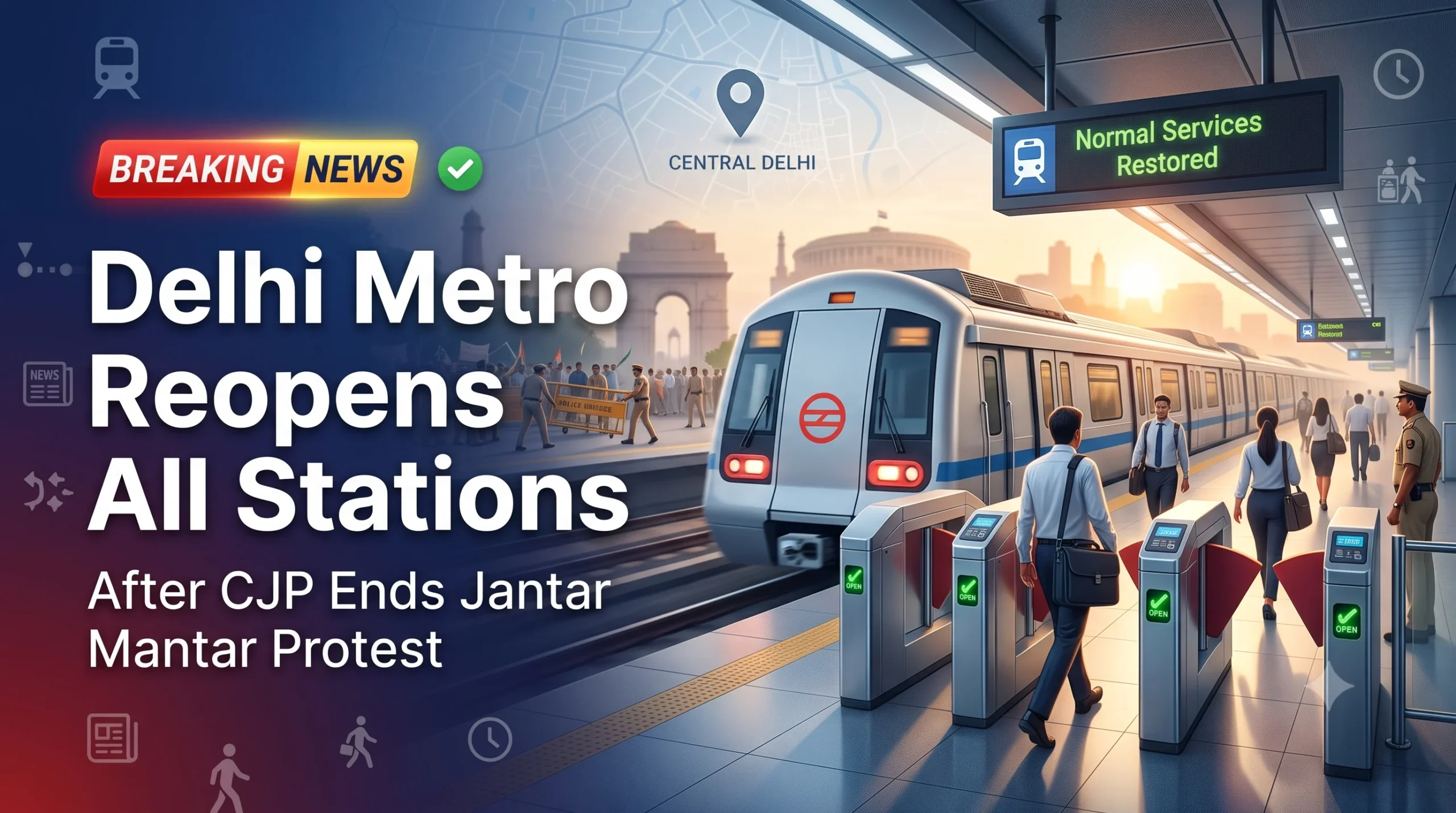
After four tense days of disruption, Delhi’s commuters can finally breathe easy. The Delhi Metro Rail Corporation (DMRC) has reopened all stations across its network following the withdrawal of the Jantar Mantar agitation led by the Cockroach Janta Party (CJP). The announcement, made on Sunday, July 26, brings an end to one of the most significant metro disruptions the capital has seen in recent years, one that had shut down 18 key stations in the heart of central Delhi and left thousands of daily travelers scrambling for alternate routes.
If you’ve been searching for updates on “Delhi Metro station closed today” or “why is Rajiv Chowk metro shut,” this article breaks down everything you need to know: what triggered the closures, how the situation unfolded day by day, and what has changed now that normal operations have resumed.
Why Were Delhi Metro Stations Closed in the First Place?
The story begins with a protest that had been building for over a month. The CJP, along with activist Sonam Wangchuk, had been staging a sit-in at Jantar Mantar over the NEET-UG paper leak controversy, a demonstration that eventually stretched into a 26-day hunger strike. As the protest grew in scale and drew larger crowds into central Delhi, security agencies began recommending precautionary closures of metro stations located near the protest site.
<cite index=”4-1″>The DMRC had announced the temporary closure of 18 metro stations across Central Delhi, citing heightened security arrangements in view of the ongoing student protests over the NEET paper leak issue.</cite> This wasn’t an isolated, one-day shutdown either. The closures persisted for four consecutive days, making it one of the longest sustained metro disruptions linked to a protest in recent memory.
The 18 Stations That Were Shut Down
For commuters trying to plan their routes over the past few days, here is the full list of stations that had entry and exit gates suspended:
- Lok Kalyan Marg
- Rajiv Chowk
- Patel Chowk
- Ramakrishna Ashram Marg
- Barakhambha Road
- Supreme Court
- Seva Teerth
- Janpath
- Mandi House
- Central Secretariat
- ITO
- Delhi Gate
- Indraprastha
- Khan Market
- Jor Bagh
- Shivaji Stadium
- Jhandewalan
- New Delhi
Given that this list includes some of the busiest interchange stations on the network, including Rajiv Chowk, New Delhi, and Central Secretariat, the impact on daily office-goers, students, and tourists was severe. Peak-hour commutes through central Delhi essentially had to be rerouted for days.
Day-by-Day Timeline of the Closures and Reopening
Day 1–3: Security restrictions kick in, and DMRC begins staggered closures at the 18 stations amid the growing scale of the protest and rising footfall at Jantar Mantar.
Day 4 (Saturday): A partial easing begins. <cite index=”1-1″>The DMRC reopened entry and exit gates at Rajiv Chowk, Mandi House, and Central Secretariat stations, even as the remaining 15 stations continued to stay shut.</cite> This came shortly after a major political development, Union Education Minister Dharmendra Pradhan’s resignation, submitted directly to Prime Minister Narendra Modi.
Saturday evening: Following three rounds of negotiations between Union Health Minister JP Nadda, Union Minister Jitendra Singh, and CJP representatives Saurav Das and Ashutosh Ranka, the Centre agreed to the protesters’ core demands. The CJP subsequently announced it was calling off the agitation.
Saturday night: DMRC moved quickly. Gates at all remaining stations were reopened, with the corporation confirming on X (formerly Twitter) that entry access across the network had been restored.
Sunday, July 26: Full normalcy returns. <cite index=”2-1″>DMRC confirmed that all stations of the Delhi Metro network were open for both entry and exit, officially ending days of security restrictions and staggered closures.</cite>



What the CJP Said About Ending the Protest
The Cockroach Janta Party framed its decision to withdraw as an act of good faith rather than a retreat. According to the party’s chief spokesperson, Saurav Das, the group agreed to end the agitation on the understanding that the government’s commitments would be honored within the agreed timeline. The statement signaled that while the sit-in has ended, the CJP is treating the government’s assurances as a binding commitment rather than a final resolution.
This nuance matters for anyone tracking the story further. Political observers note that protest movements which end on “assurances” rather than concrete legislative or policy action sometimes resume if commitments aren’t met, so this may not be the final chapter in the NEET-UG paper leak saga.
The Bigger Picture: A Minister’s Resignation and a Month-Long Standoff
It’s worth zooming out here. This wasn’t a protest that emerged overnight. The demonstration at Jantar Mantar had been running for over a month, fueled by public anger over irregularities in the NEET-UG examination process. Sonam Wangchuk’s prolonged hunger strike added significant national attention to the cause, turning what might have remained a localized student protest into a major political flashpoint.
<cite index=”3-1″>The pressure ultimately led to Dharmendra Pradhan stepping down as education minister, following the month-long protest and the 26-day hunger strike by Wangchuk.</cite> His resignation is widely seen as the turning point that opened the door for talks and, eventually, the protest’s withdrawal.
Internet Restrictions Lifted Alongside Metro Reopening
Metro stations weren’t the only thing affected. Authorities had also imposed mobile internet restrictions in and around Jantar Mantar as the protest intensified, a measure typically used to limit real-time coordination among large crowds. With the agitation now called off, internet services have been restored across the protest site and neighboring areas of central Delhi, marking a broader return to normal life in the district.
How the Closures Affected Commuters
For four days, anyone relying on the Yellow, Blue, or Violet lines through central Delhi had to rethink their daily commute. Delhi Police issued advisories urging people to avoid the New Delhi area altogether due to heavy congestion, both on the roads and around metro entry points. Commuters were repeatedly told to use alternative routes to avoid delays, a request many found difficult to follow given how central these stations are to the city’s transit network.
Ride-hailing costs in the affected zones reportedly spiked, and foot traffic near alternate stations increased significantly as commuters tried to work around the shutdown. Office-goers in the Central Secretariat and Connaught Place areas, students heading to institutions near Mandi House, and tourists visiting India Gate and nearby monuments all felt the pinch.
What Happens Now?
With all stations back online, the Delhi Metro network has returned to its usual operating rhythm. However, several questions remain open for the coming weeks:
- Will the government follow through on its assurances to the CJP? The protest’s resolution rests on promises, not finalized policy changes.
- Could there be a repeat shutdown? If commitments aren’t met within the agreed timeline, another round of protests, and potentially renewed metro restrictions, cannot be ruled out.
- What replaces Dharmendra Pradhan as education minister? This appointment will likely shape how the NEET-UG reform process unfolds going forward.
For now, though, the immediate crisis is over. DMRC’s swift move to restore full service within hours of the protest’s official end reflects how tightly metro operations in the capital are tied to the security situation on the ground, something Delhi commuters have grown accustomed to navigating over the years.
Quick Recap: Key Facts
- What happened: All 18 previously closed Delhi Metro stations reopened after the CJP called off its Jantar Mantar protest.
- Why stations were closed: Security concerns tied to a month-long protest over the NEET-UG paper leak, including a 26-day hunger strike by Sonam Wangchuk.
- Trigger for resolution: Union Education Minister Dharmendra Pradhan’s resignation, followed by talks between government representatives and CJP leaders.
- When normalcy returned: Entry gates reopened Saturday night; full service, including exit gates, resumed Sunday, July 26.
- Other changes: Mobile internet restrictions around Jantar Mantar were also lifted.
Frequently Asked Questions
Q: Which Delhi Metro stations were closed during the CJP protest? A: 18 stations were closed, including Rajiv Chowk, New Delhi, Central Secretariat, Mandi House, Khan Market, ITO, and Janpath, among others.
Q: Why did the CJP protest at Jantar Mantar? A: The protest was centered on the NEET-UG paper leak issue, with activist Sonam Wangchuk conducting a 26-day hunger strike as part of the agitation.
Q: Are all Delhi Metro stations open now? A: Yes. As of Sunday, July 26, DMRC confirmed that both entry and exit gates at all stations across the network are fully operational.
Q: Did anyone resign because of the protest? A: Yes, Union Education Minister Dharmendra Pradhan resigned following the sustained pressure from the month-long protest.
This article will be updated as more details emerge on the government’s follow-through on its commitments to the CJP.