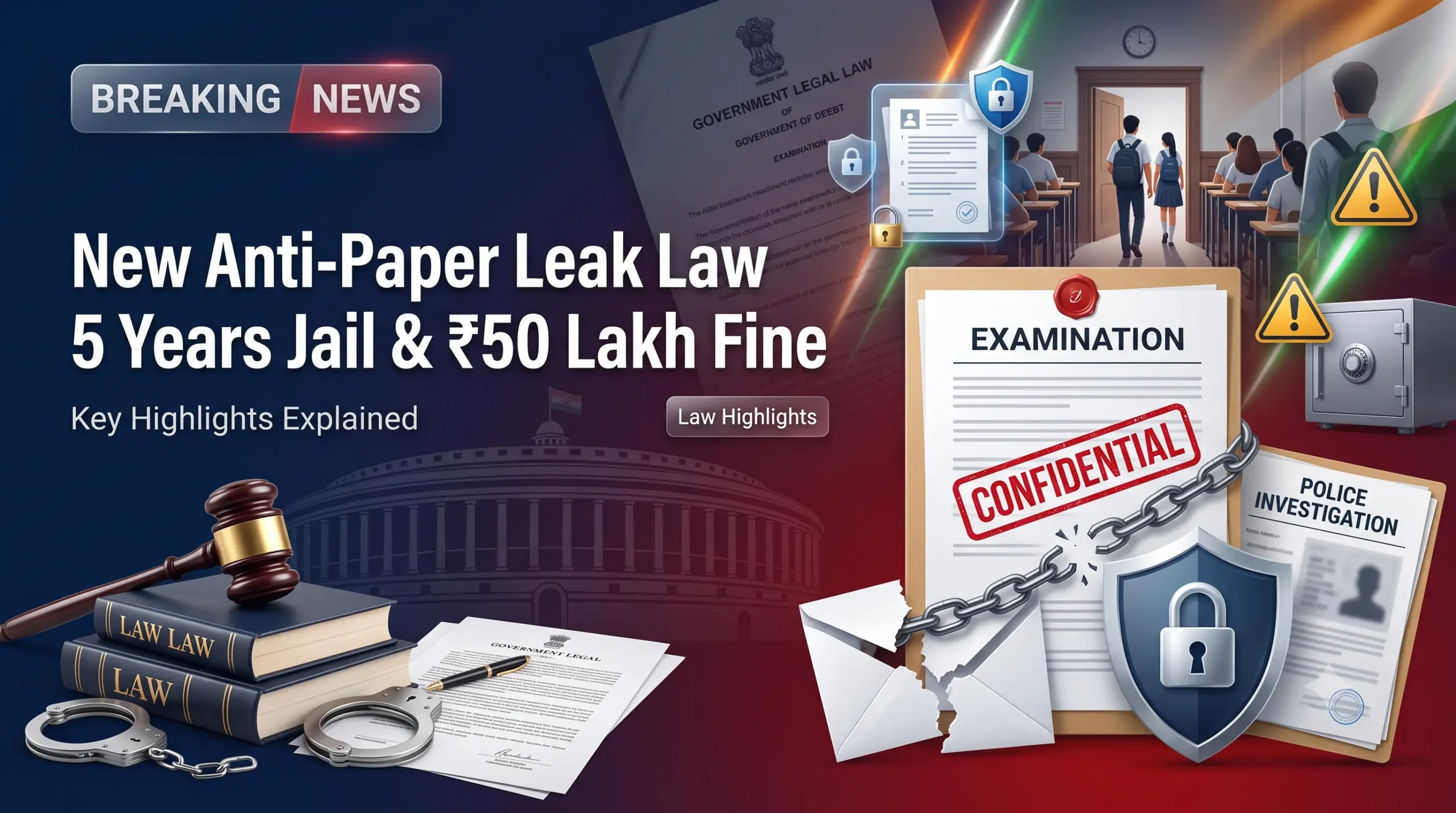
Exam paper leaks have haunted Indian students for years, derailing recruitment drives, delaying results, and eroding trust in the entire public examination system. In response to nationwide protests over irregularities in exams like NEET-UG, the central government has moved to sharply toughen India’s anti-paper leak law. Here’s a complete breakdown of what the new law proposes, why it matters, and how it changes the legal landscape for exam fraud in India.
Background: Why a New Law Was Needed
India already had a dedicated law against exam malpractice — the Public Examinations (Prevention of Unfair Means) Act, 2024. Under this original law, individuals caught leaking question papers faced imprisonment ranging from three to five years along with a fine of up to Rs 10 lakh, while organised crime related to paper leaks attracted five to ten years’ imprisonment and fines up to Rs 1 crore.
However, this framework proved insufficient to stem the tide of leaks. The NEET-UG controversy triggered weeks of student unrest across the country, and public anger eventually forced the resignation of the Union Education Minister. Following the protests, Prime Minister Narendra Modi promised a stronger law to deal with cases like the NEET-UG paper leak, setting the stage for the Public Examinations (Prevention of Unfair Means) Amendment Bill, 2026.
Key Highlights of the New Anti-Paper Leak Law
1. Harsher Jail Terms for Individuals
The most significant change is in sentencing. The jail term for individuals involved in unfair means such as paper leaks has been increased from three-to-five years under the 2024 Act to five-to-ten years. This means every convicted individual will now serve a minimum of five years behind bars — with no room for a lighter three-year sentence as before.
2. Fine Hiked Five-Fold
Financial penalties have also been steeply increased. The fine for individual offenders has been raised from Rs 10 lakh to Rs 50 lakh, a five-fold jump designed to make paper leaks financially ruinous, not just a legal risk.
3. Even Tougher Punishment for Organised Crime
Recognising that most large-scale leaks involve organised syndicates rather than lone individuals, the amended Bill sets aside even harsher penalties for organised crime. In cases found to be organised, the Bill proposes a minimum sentence of seven years and a fine of up to Rs 10 crore.
4. Service Providers and Exam Agencies Under the Scanner
For the first time, private companies that run computer-based tests or logistics for public exams face direct criminal liability. Senior management or persons in-charge of a service provider firm will face between five and ten years in jail, with a fine of Rs 5 crore, up sharply from the earlier law. Additionally,the service provider can be fined up to Rs 5 crore, made to pay the proportionate cost of the examination, and barred from being assigned responsibility for any public exam for eight years — compared to a four-year debarment and Rs 1 crore fine previously.
5. Fifteen Specific Offences Listed
To close legal loopholes, the amended law spells out 15 specific illegal acts as offences, including leaking question papers, tampering with OMR sheets, creating fake websites, and issuing fake admit cards. This detailed list makes it harder for offenders to argue that their specific method of cheating falls outside the law’s scope.
6. Faster Investigations and Fast-Track Courts
One of the biggest complaints against the earlier system was the painfully slow pace of investigation and trial. The new Bill directly addresses this. Investigations into paper-leak cases must now be completed within two months, and states and Union Territories will be empowered to set up fast-track courts capable of finishing trials within three months of the chargesheet being filed.
7. Central Task Force for Serious Cases
For cases that cross state boundaries or involve complex networks,the Centre will have the authority to constitute a special task force to investigate certain cases, ensuring that large, coordinated leak operations don’t slip through jurisdictional gaps.
8. Wide Coverage of Exams and Agencies
The law’s reach is broad. It covers public examinations conducted by the UPSC, Staff Selection Commission, Railway Recruitment Boards, the Institute of Banking Personnel Selection, central government ministries and departments, the National Testing Agency, and other similar authorities. This means competitive exams across sectors — from railways to banking to civil services — now fall under one unified, stringent legal framework.
9. A Parallel Push for Systemic Reform
Legislation alone isn’t the only response. The government has also announced a task force headed by Infosys co-founder Nandan Nilekani to recommend reforms aimed at making the public examination system leak-proof. This signals an effort to tackle the problem both through deterrent punishment and structural, technology-driven prevention.
What This Means for Students and Exam Aspirants
For the lakhs of students who sit for competitive exams every year, this amendment is a significant reassurance. Paper leaks don’t just cost students money spent on preparation — they cost months or years of career delays and immense psychological stress. By making punishments harsher, mandating time-bound investigations, and holding service providers accountable, the new law aims to restore faith in the fairness of India’s public examination system.
At the same time, some past cases show how long-standing the problem is — one railway exam paper leak case took 23 years to conclude, with convicts eventually receiving a five-year sentence. The new law’s emphasis on fast-track courts and two-month investigation deadlines is a direct attempt to prevent such delays in the future.
Conclusion
The Public Examinations (Prevention of Unfair Means) Amendment Bill, 2026 marks one of the most decisive crackdowns yet on exam fraud in India. With jail terms of at least five years, fines up to Rs 50 lakh for individuals, and even steeper penalties of up to Rs 10 crore for organised rackets and negligent service providers, the government is signaling zero tolerance for those who compromise the integrity of public examinations. Whether this translates into fewer leaks on the ground will depend on effective enforcement — but on paper, it is one of the strongest anti-cheating laws India has seen.
This article is based on developments reported as of late July 2026. As the Bill moves through Parliament, provisions may be revised before final enactment — readers are encouraged to check official government sources for the final notified law.