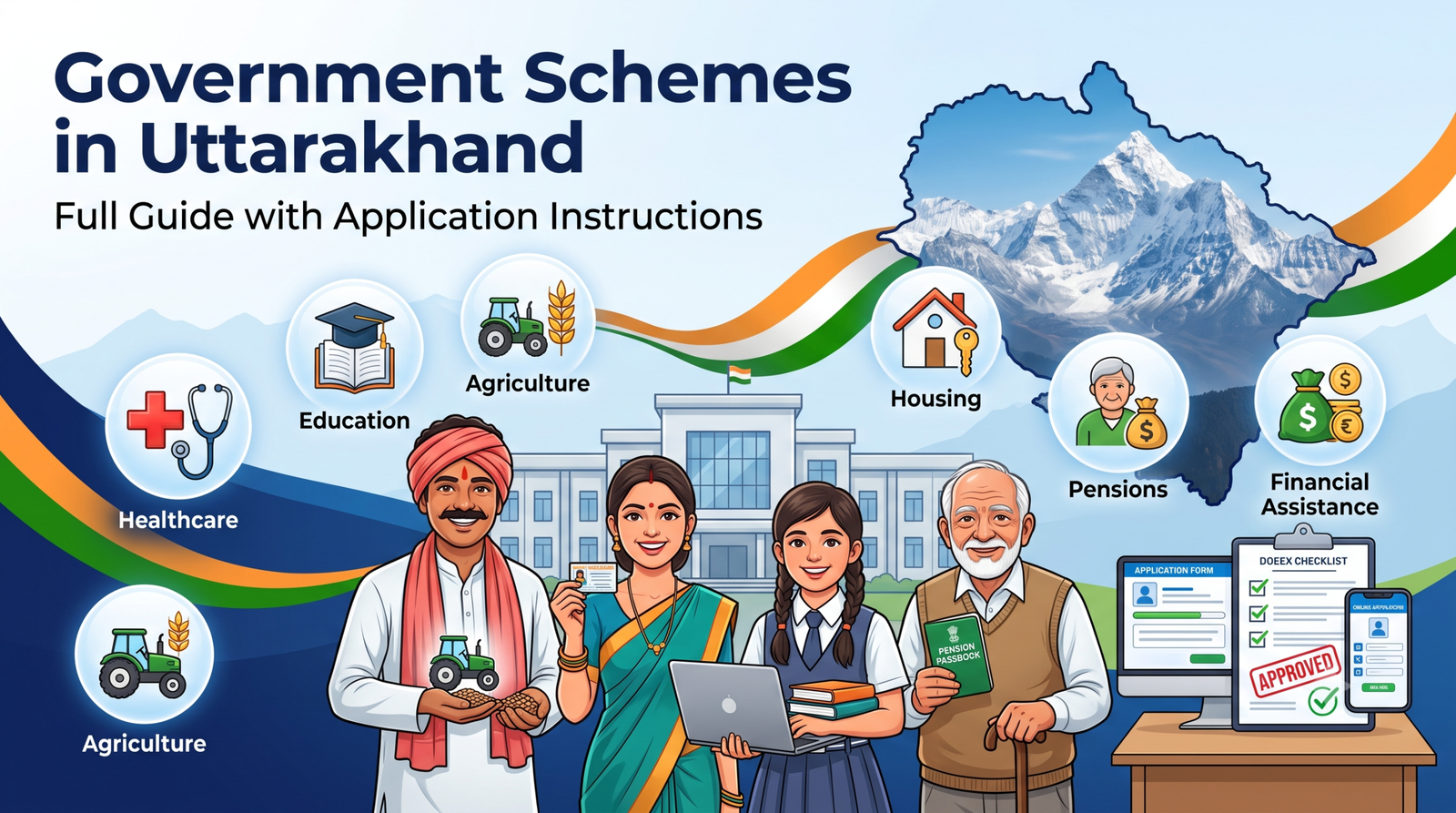
Uttarakhand’s mountainous terrain, scattered hill settlements, and long history of out-migration make it a state where targeted welfare support matters more than most. Over the past few years, the state government has built a fairly wide safety net — covering healthcare, maternal and child welfare, education, self-employment, and old-age security — that works alongside central schemes like PM-JAY and PM-KISAN. Below is a practical rundown of Uttarakhand’s major state schemes, followed by clear, step-by-step instructions on how to actually apply for them.
1. Health Cover: Atal Ayushman Uttarakhand Yojana (AAUY)
AAUY is the state’s flagship health insurance scheme, layered on top of the central Ayushman Bharat (PM-JAY) programme. While PM-JAY is limited to families listed in the Socio-Economic Caste Census, AAUY extends a cashless hospitalisation cover of ₹5 lakh per family per year to every permanent resident of the state, regardless of income.
How to apply: Head to any empanelled government or private hospital, a nearby Common Service Centre (CSC), or ask for the on-site “Arogya Mitra.” Carry your Aadhaar card and a ration card or other residence proof to complete e-KYC and get your family’s “Golden Card” issued. Once you have it, treatment at any listed hospital is cashless, and genuine emergencies don’t need a prior referral.
2. Women and Child Welfare
Two schemes stand out here:
- Mukhyamantri Mahalaxmi Kit Yojana gives mothers of their first two daughters (or twin girls) a free kit of nutrition, hygiene, and baby-care essentials after an institutional delivery. To claim it, register the pregnancy at your nearest Anganwadi Centre and submit a copy of your Mother-Child Protection (MCP) card with the application; the kit itself is handed over at the same centre after birth. Families where the mother pays income tax aren’t eligible.
- Mukhyamantri Ghasiyari Kalyan Yojana targets hill women who traditionally walk into forests to cut fodder for their cattle, often at real physical risk. It supplies subsidised packaged silage and mixed cattle feed through cooperative centres at a fraction of market cost. You need to be a permanent resident who owns milch animals, and can register through the Uttarakhand Cooperative Department’s scheme page.
3. Education and Scholarships
- The Uttarakhand Scholarship Scheme gives school students a monthly stipend that increases with each class, aimed squarely at keeping children from low-income families in school. Applications are usually routed through the school itself to the Education Department.
- The Chief Minister’s Higher Education Scholarship rewards meritorious graduate and postgraduate students at government colleges and universities, based on their rank and marks in the previous exam. It’s applied for through the Samarth portal used by the Directorate of Higher Education, not through the general e-District system.
4. Employment and Self-Employment
- Mukhyamantri Swarojgar Yojana (MSY) is the state’s flagship self-employment scheme, arranging bank loans of up to ₹25 lakh with a 25% capital subsidy (capped at ₹6.25 lakh) for manufacturing, trade, or service ventures — everything from a gym to a mobile-repair shop. You must be a permanent resident who hasn’t taken a similar self-employment loan in the last five years; the District Industries Centre (DIC) screens applications before forwarding them to empanelled banks.
- Mukhyamantri Saur Swarojgar Yojana applies the same idea to solar power: set up a small plant on barren or leased land and sell the electricity to the Uttarakhand Power Corporation at a fixed rate, with loans available at around 8% interest through cooperative banks.
Both are applied for at msy.uk.gov.in, or in person at your local DIC office.
5. Social Security: Pension Schemes
The Social Welfare Department runs old-age, widow, and disability pension schemes, together paying out roughly ₹1,200 a month (a mix of central and state funds) to eligible residents. Old-age pension generally applies from age 60 onward, while widow and disability pensions carry their own income and medical-certification criteria. Because exact amounts and eligibility limits are revised periodically, it’s worth confirming the current rate and criteria on the department’s site before you apply.
6. Agriculture, Housing, and Rural Employment
Farmers can draw on both central and state support. The Pradhan Mantri Fasal Bima Yojana (PMFBY) insures crops against loss for a modest premium (around 1.5–2% of the sum insured for food crops), PM-KISAN deposits ₹6,000 a year into eligible farmers’ accounts in three instalments, and the state’s own Deen Dayal Upadhyay Kisan Kalyan Yojana pushes organic farming, better seeds, and market linkages suited to hill agriculture.
For housing and rural livelihoods, the Pradhan Mantri Awas Yojana funds pucca houses for eligible rural (Gramin) and urban families, while MGNREGA guarantees up to 100 days of paid rural employment a year at the notified daily wage. All of these are applied for at the Gram Panchayat, the Municipal or block office, or through the Common Service Centre network, using the same Aadhaar, land-record, and bank-account documents needed for most other schemes.
How to Apply: Step-by-Step Instructions
Nearly every Uttarakhand scheme funnels through one of three routes.
Step 1 — Identify the right department. Health goes through the State Health Authority, certificates and pensions through Social Welfare or Revenue, self-employment through Industries, and maternal welfare through Women Empowerment & Child Development.
Step 2 — Use the e-District Uttarakhand portal for certificates and pensions. This single-window system — also called Apuni Sarkar / e-Services — is accessible at eservices.uk.gov.in.
- Click “Sign Up,” register with your name, mobile number, and email ID, then verify the OTP.
- Log in and pick the required service from the department-wise list.
- Fill in the form, upload scanned documents, and pay the small processing fee (typically around ₹30 plus a service charge) via UPI, card, or net banking.
- Note your application number to track status online, and download the certificate once it’s approved.
Step 3 — Use scheme-specific portals where they exist. Self-employment schemes run through msy.uk.gov.in, health cover through the AAUY portal, and the higher-education scholarship through the Samarth portal — none of these go through e-District.
Step 4 — Apply offline for kit-based welfare schemes. The Mahalaxmi Kit and similar nutrition-linked schemes are handled entirely at the Anganwadi Centre; there’s no online form to fill for these.
Step 5 — Get help at a Common Service Centre (CSC). If the online process feels unfamiliar, any CSC operator can fill and submit most forms for a small fee. For portal issues specifically, the e-District helpline (1905, toll-free) can help.
Documents to Keep Ready
- Aadhaar card, linked to an active mobile number
- Residence/domicile certificate or voter ID
- Ration card (needed especially for AAUY and pension schemes)
- Income certificate, for income-linked schemes
- Passport-size photograph
- Bank passbook copy, for schemes paid via direct benefit transfer
- Category certificate, if applying under an SC/ST/OBC quota
A Quick Note on Staying Safe
Scheme names, benefit amounts, and portals in Uttarakhand are revised fairly often, and plenty of unofficial sites mimic government pages closely. Before applying, cross-check details on the relevant department’s official website or with your nearest CSC, and never pay anyone beyond the listed government fee — every scheme mentioned here is free to apply for directly.